
Tag: Africa

Somalia & Somaliland: Battlegrounds as Turkey and Israel Seek the Control of the Red Sea

Somalia & Somaliland: Battlegrounds as Turkey and Israel Seek the Control of the Red Sea

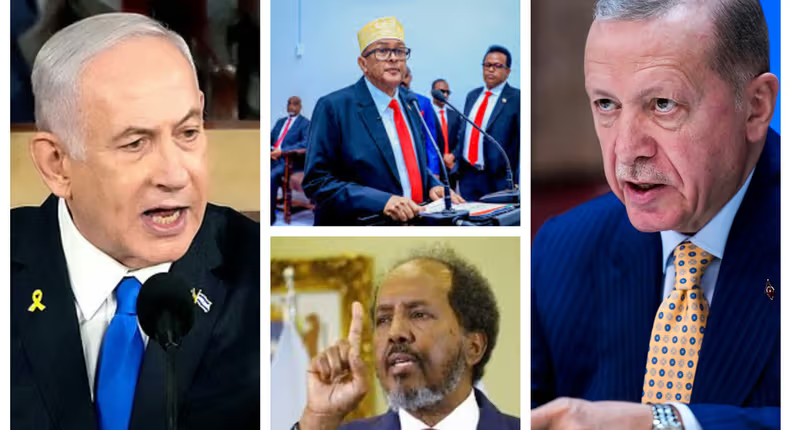
Turkey and Israel are intensifying competition in the Horn of Africa, with Somalia and Somaliland emerging as key battlegrounds for oil, military influence and control of vital Red Sea trade routes.

Turkey has consolidated its position through formal agreements with Somalia’s federal government, securing major offshore and onshore oil and gas exploration rights alongside a strong military presence through its largest overseas training base. Israel, meanwhile, has moved closer to Somaliland after becoming the first country to formally recognize the territory as an independent state and is exploring plans for a military base near the Gulf of Aden to monitor Yemen’s Houthis and secure strategic access to the Red Sea corridor.

Earlier this year, Somalia confirmed it was ready to begin its first offshore oil drilling operations, with a Turkish government-owned drilling ship expected to arrive off its coast, according to BBC. The move followed the successful completion of seismic surveys last year by Turkey’s research vessel Oruç Reis, which collected 3D seismic data across key offshore blocks.

Somalia is estimated to hold at least 30 billion barrels of offshore oil potential and around 6 billion cubic meters of natural gas, though much of it remains unproven compared with established producers such as Libya and Nigeria.

Since 2011, Turkey has become one of Mogadishu’s closest allies, combining humanitarian support, military training and infrastructure investment. In December 2025, Turkish President Recep Tayyip Erdoğan said Ankara planned to establish a spaceport in Somalia.

Subsequent reports later confirmed that Turkey was exploring a broader aerospace facility, including a spaceport for satellite and possible missile launches, alongside plans for a naval base, while F-16 fighter jets were deployed inside Somalia in early 2026. In February 2026, Turkey also dispatched ageing U.S.-made M48 and M60 tanks through the streets of Mogadishu in a protected convoy after they were unloaded from a Turkish Navy landing ship.

According to reports, the tanks were deployed to secure Turkish facilities in the Warsheikh area, about 37 miles north of the capital, where Ankara is building the site for satellite launches and broader aerospace operations. Separately, Turkey recently reopened its $50 million military base in Mogadishu, reinforcing Ankara’s role in Somalia’s security sector and its support for the training of Somali National Army soldiers, including elite units involved in operations against Al-Shabaab.

Israel, meanwhile, has focused on Somaliland, whose coastline faces Yemen across the Gulf of Aden. Prime Minister Benjamin Netanyahu announced in late 2025 that Israel had formally recognized Somaliland, describing the decision as being “in the spirit of the Abraham Accords.” The recognition triggered strong condemnation from Somalia and several Arab countries, including Saudi Arabia, Palestine, Egypt, Kuwait, Iraq, Jordan and Qatar, all of which rejected the decision as illegal and warned that it threatened regional stability and Somalia’s territorial unity.

Turkey also criticized the move, with President Recep Tayyip Erdoğan calling Israel’s recognition of Somaliland “illegitimate and unacceptable” and later saying it “does not benefit” the region during a February visit to Ethiopia, one of Israel’s key allies in the Horn of Africa.

Despite the criticism, a Bloomberg report in March confirmed that Israel was exploring plans to build a military base in Somaliland to monitor and target Yemen’s Houthis, taking advantage of the region’s strategic location near the Bab el-Mandeb Strait. Defending the move, Shiri Fein-Grossman, chief executive of the Israel-Africa Relations Institute and a former member of Israel’s National Security Council, told Israeli outlet i24 News: “Everyone just looks at the map and understands what Israel is looking for here.”

“The recognition of Somaliland gives Israel a strategic location near the Houthis in Yemen and comes at a time that Israel needs as many friends as possible.”

Beyond Somalia and Somaliland, tensions between Turkey and Israel have deepened over Gaza, Syria and wider regional power projection, further exposing a growing geopolitical rivalry between the two military powers.

Middle East Eye reported that Prime Minister Benjamin Netanyahu has increasingly shifted his rhetoric towards Turkey as Ankara expands its influence across the eastern Mediterranean and Africa, particularly around Cyprus and Greece. In a post on X, Netanyahu accused President Recep Tayyip Erdoğan of “massacring his own Kurdish citizens” and “accommodating Iran’s terror regime and its proxies”.

Turkey responded with sharp condemnation, with officials in Ankara describing Netanyahu as the “Hitler of the era”, citing Israel’s military actions in Gaza and across the region.

While Somalia and Somaliland remain central to their competition in the Horn of Africa, the broader dispute reflects a much wider struggle for influence stretching from the Red Sea to the Middle East, with both military powers seeking strategic bases in the two African territories to strengthen their regional reach.

Olamilekan Okebiorun is a business journalist covering markets, technology, and changing landscape of African economies for Business Insider Africa.

Dr. Pham’s Pick Sealed Trump’s Somaliland Recognition


Dr. Pham’s Pick Sealed Trump’s Somaliland Recognition

Dr. Pham frequently shares Somaliland’s achievements and how each step is heading in the right direction on the X platform, formerly known as Twitter, demonstrating his strong support for the country’s independence and sovereignty. He also makes the important point that, in spite of the billions of US money spent on it, Somalia is a failed state with nothing promising in the works. Continue reading “Dr. Pham’s Pick Sealed Trump’s Somaliland Recognition”

Fixing Africa’s Governance Crisis Must Come First

Fixing Africa’s Governance Crisis Must Come First

African leaders may be able to learn from the forthcoming elections in Somaliland, which are set for November 13, 2024. For the rest of Africa, Somaliland’s peaceful transitions of power and subsequent presidential elections can serve as a model for effective governance.

African leaders – and their counterparts in Western countries and international organizations such as the United Nations, the International Monetary Fund, and the World Bank – often misdiagnose the continent’s development challenges. More than increased aid, debt relief, and foreign investment, Africa needs to resolve its governance crisis – the source of all its problems.

The continent must focus on developing the competence required to govern itself effectively and drive its own development trajectory. That means boosting state capacity at the most basic level to enable African governments to secure borders, raise revenue through taxation, and provide social services and other public goods. Without these reforms, Africa’s countries will continue to fail to deliver stability and broad-based prosperity, and most external financing will continue to be mis-allocated and misappropriated, resulting in sub-optimal outcomes for the poor. For starters, the continent’s many “ungoverned spaces” have allowed terrorist groups – from Boko Haram and the Islamic State West Africa Province (ISWAP) in Nigeria and the Sahel to Al-Shabaab in East Africa – to proliferate. They have also nurtured large-scale conflicts in Sudan, the Democratic Republic of the Congo, Mozambique’s Cabo Delgado province, and elsewhere. To protect their citizens against violence, African governments must regain full control of their territories.

African governments must also improve their tax systems, the anchor of any modern economy. The ratio of tax revenue to GDP is mostly in the high single and low double-digit percentages on the continent, significantly lower than in most European and Asian countries. The resulting budget shortfalls have fueled a penchant for foreign borrowing that has pushed some African countries into debt distress.

This state of affairs reflects two main factors. First, many Africans are reluctant to pay taxes, because they do not trust their government to use budget revenue to finance public goods. Too often, corrupt politicians and officials raid the state’s coffers. Second, many African countries have large informal economies, with most people and businesses operating outside the tax net. Widening that net would go a long way toward fixing the problem, and is a better alternative to levying high rates on a narrow base. But African countries must also improve their ability to provide basic services such as health care, education, potable water, and sanitation. Most of the continent’s governments, however, worship at the altar of GDP, using it as their main measure of economic progress. As a result, Africa’s resource-rich and commodity-dependent countries fail to achieve the kind of broad-based, sustainable growth that lifts millions out of poverty.

Paradoxically, the shift from military dictatorships to multiparty democracy in Africa over the past three decades has not yielded better results, because political power has become unmoored from good governance. African leaders now fixate on winning, by hook or by crook, conducting ritualistic elections that often lack transparency and truly independent monitors. Moreover, politics in many African countries is shaped by ethnic tensions, owing to the legacy of arbitrarily drawn colonial boundaries. Voters tend to decide whom to support based on candidates’ sectarian identities – and their willingness to give handouts. High levels of illiteracy only add to the challenges that democracy faces on the continent. If Africa is to strengthen state capacity, it needs competent technocratic governments and strong institutions. Elected politicians must resist the temptation to pack agencies that ought to be independent and apolitical with unqualified, sycophantic party hacks. Equally important, skills that are often absent or lacking among the continent’s politicians and officials must be established at scale. These include knowledge of economics, public policy, program evaluation and monitoring, data analytics, statistics, risk management, urban policy, local government administration, public-private partnerships, and international political economy.

Home-grown academic institutions are starting to fill this human-capital gap. One of the most promising new entries is the African School of Governance, of which I am president. Located in Kigali, Rwanda, this professional graduate school offers public-policy and leadership education and research programs that are distinctly African. Established by continental leaders, including Rwandan President Paul Kagame and former Ethiopian Prime Minister Hailemariam Desalegn, and with support from the MasterCard Foundation, the university aims to train politicians and bureaucrats to overcome the obstacles impeding Africa’s progress on achieving sustainable growth. African leaders must now focus on preparing those who will take the baton from them. They and anyone else who supports Africa’s aspirations should support independent initiatives – like the African School of Governance – that seek to address the roots of the continent’s development challenges. The uncomfortable truth is that Africa lags behind the rest of the world largely because it is poorly governed. Blaming other factors – whether the legacy of colonialism or the influence of external actors – is merely an excuse for inaction.

Author: Kingsley Moghalu, a former deputy governor of the Central Bank of Nigeria, is President of the African School of Governance, an independent, pan-African graduate school in Kigali, Rwanda

Is Vocational Training a Way Forward for Somaliland Development

Is Vocational Training a Way Forward for Somaliland Development ?
For many young Africans, especially those from marginalised communities, TVET is a pathway out of poverty. Equally, to build up a nation there needs to be a labour force equipped with the practical skills Continue reading “Is Vocational Training a Way Forward for Somaliland Development”

Somaliland’s Persistent Ignorance on How Interests Shape Foreign Policy

Somaliland’s Persistent Ignorance on How Interests Shape Foreign Policy

Discussion on why Qatar and Turkey support the Mogadishu-based government, and this will likely be a very important note before the Presidential election. Continue reading “Somaliland’s Persistent Ignorance on How Interests Shape Foreign Policy”

Implications of US Retreat from the Sahel

Implications of US Retreat from the Sahel

As America’s global rivalry with Russia and China intensifies, its ability to project military, diplomatic and economic influence in Africa faces mounting challenges. Continue reading “Implications of US Retreat from the Sahel”

Africa Needs Regional Trade Hubs to Succeed

Africa Can’t Prosper Without Regional Trade

Strengthening the trade between African countries is a necessary first step toward equipping the continent to engage with the world economy on its own terms. For too long, Africa has been trading with others on terms that ensure its place at the bottom of the global value chain. Continue reading “Africa Needs Regional Trade Hubs to Succeed”

A Marshall Plan for Africa

A Marshall Plan for Africa

Africa could be the largest source of global economic growth over the next half-century. But during the same period, the continent could also trigger the next great European war. Continue reading “A Marshall Plan for Africa”

Somaliland Among Few in Africa with 5G Network

Somaliland Among Few in Africa with 5G Network

Somtel Rolls out 5G Network in Somaliland Continue reading “Somaliland Among Few in Africa with 5G Network”

How Italy Aided in the Ruin of Somalia & Fighting SNM

How Italy Aided in the Ruin of Somalia & Fighting SNM

The agony of Somalia has its roots in the endemic political corruption of Italy. Throughout the 1980s, Italian politicians and businessmen used the country, once a colony of Italy’s, as a playground for huge construction projects that either did little to help the local population or actually disrupted and damaged Somalian society. Continue reading “How Italy Aided in the Ruin of Somalia & Fighting SNM”