
Tag: recognition

Somaliland’s Geopolitical Relevance Outpacing Its Institutional Preparedness

Somaliland’s geopolitical relevance is rising faster than its institutional preparedness
In an era of intensifying global competition along strategic maritime corridors, the Republic of Somaliland sits at a crossroads few policymakers can afford to ignore. Positioned along the Gulf of Aden, near the Bab el-Mandeb strait through which roughly around 12% of global trade passes, Somaliland occupies territory that is no longer peripheral to global strategy. It is central.
Yet Somaliland’s geopolitical relevance is rising faster than its institutional preparedness.
For over three decades, Somaliland has defied regional patterns. It has built a functioning political order, conducted competitive elections, and maintained relative internal stability without formal international recognition. These achievements are not accidental. They are the result of leadership.
From the early stewardship of Abdirahman Ahmed Ali (Tuur), who guided the fragile reassertion of sovereignty, to the state-building vision of Mohamed Haji Ibrahim Egal, Somaliland’s trajectory has been shaped by leaders capable of navigating crisis and compromise. Egal’s demobilization of militias and institutional consolidation remain foundational to Somaliland’s governance model.
This pattern of leadership continuity extended through Dahir Riyale Kahin, whose administration entrenched electoral legitimacy, and Ahmed Mohamed Mohamoud (Silanyo), whose economic diplomacy, particularly the Berbera Port agreement with DP World, signalled Somaliland’s entry into the geopolitical economy of the Red Sea corridor.
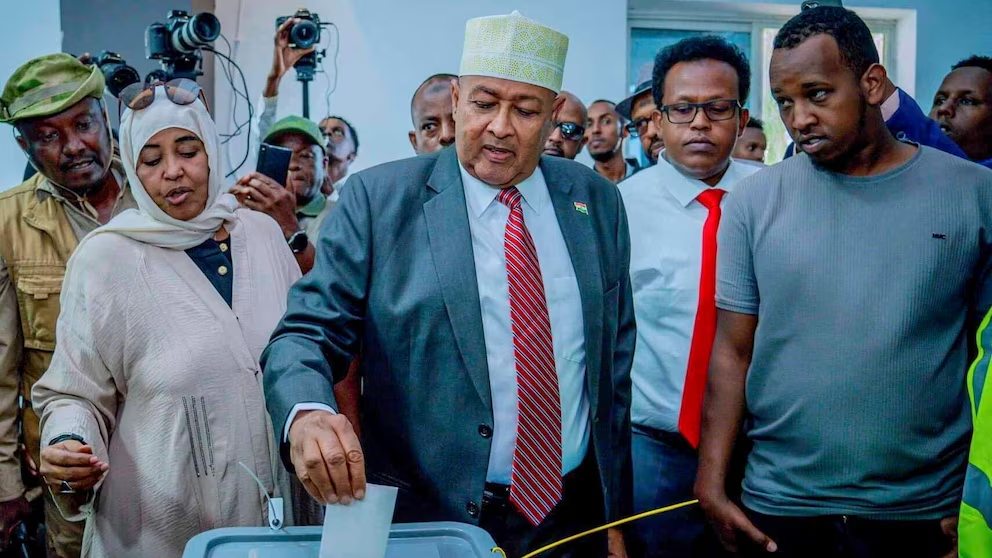
Under Muse Bihi Abdi, the state navigated rising internal political contestation and external pressure, while expanding its diplomatic outreach. Today, Abdirahman Mohamed Abdullahi (Iro) presides over a decisive phase, as Somaliland seeks to convert de facto statehood into formal international recognition, an aspiration first answered by the State of Israel in December 2025 after its PM announced a ‘full recognition’ of Somaliland’s sovereignty.
But here lies the paradox: as Somaliland’s strategic importance grows, the model that sustained its stability is becoming insufficient.
A Strategic Location in a Crowded Theatre
The Red Sea and Gulf of Aden are undergoing rapid geopolitical transformation. The region has become a theatre of overlapping interests:
  • ​Gulf states projecting economic and security influence
  • ​Global powers securing maritime routes and military access
  • ​Regional actors competing for ports, corridors, and alliances
Berbera Port, developed through the DP World concession, has emerged as a critical node in this competition. It offers an alternative logistics corridor to landlocked Ethiopia and a potential counterweight to congested or contested routes elsewhere in the region. But this opportunity comes with exposure.
Somaliland’s economy remains highly concentrated, dependent on Berbera port revenues, livestock exports, and remittances. Its lack of international recognition limits access to global financial systems, constraining its ability to scale infrastructure, diversify its economy, and absorb external shocks.
In short, Somaliland is strategically located, but structurally constrained.
The Leadership Constraint.
Historically, Somaliland has compensated for structural limitations through leadership. Its political stability has been personality-driven; anchored in individuals with legitimacy, experience, and consensus-building capacity.
Personality-Driven model is now reaching its limits
The emerging geopolitical environment demands a different type of leadership:
  • Leaders capable of navigating multi-alignment diplomacy without or with inadequate formal recognition.
  • Leaders able to negotiate complex economic partnerships without overexposure to external actors.
  • Leaders who can translate geopolitical opportunity into domestic development.
At present, Somaliland lacks a formalized system for producing such leadership. This creates a strategic vulnerability. Without a pipeline of capable leaders, Somaliland risks entering a period where geopolitical relevance outpaces governance capacity, a gap that external actors are quick to exploit.
Recognition Is Not a Strategy
Much of Somaliland’s external engagement has been framed around the pursuit of international recognition. While recognition remains a legitimate objective, it cannot substitute for internal capacity.
Recognition, even if achieved, will not resolve:
  1.  Economic concentration
  2. Institutional fragility
  3. Youth unemployment
  4. Women and minority groups’ representational equality
  5. Governance gaps
In fact, recognition without preparation could amplify these challenges by accelerating external engagement beyond the state’s ability to manage it. The more urgent priority is internal readiness.
Policy Imperatives in a Geopolitical Context
To navigate this new era, Somaliland must recalibrate its strategy along these axes:
Strategic Autonomy in Foreign Policy:
Somaliland must avoid overdependence on any single external partner. A diversified diplomatic approach: balancing Gulf, African, and Western engagements is essential to preserve autonomy.
Economic De-Risking:
Reducing reliance on Berbera Port revenues is critical. This requires investment in trade corridors, value-added exports, and emerging sectors such as digital services.
Leadership Institutionalization:
Political parties, civil society groups, and state institutions must collectively develop mechanisms for leadership cultivation. Governance cannot remain dependent on exceptional individuals.
Inclusive State-Building
The demographic reality where youth and women form the majority must be reflected in political representation. Exclusion is not only unjust; it is destabilizing.
Governance Before Recognition:
Somaliland’s comparative advantage has been its internal legitimacy. Preserving and deepening this must take precedence over external validation.
A Narrowing Window:
Somaliland’s current position is both an opportunity and a risk. Its stability makes it attractive. Its location makes it valuable. But without institutional depth, these same factors can render it vulnerable.
The next decade will not resemble the last. The geopolitical environment is less forgiving, more competitive, and far less tolerant of governance gaps.
Somaliland’s founding generation proved that leadership can create a state under conditions of collapse. The current generation faces a different test: whether it can transform that legacy into a system capable of sustaining the state under conditions of global competition.
Failure will not come as sudden collapse but as gradual erosion of autonomy, of policy space, and of strategic control. Success, however, would place Somaliland in a rare category not merely as a stable polity in a fragile region, but as a self-made state capable of navigating great power competition on its own terms. That is the real test ahead.
About the Author:
Salma Sheikh is a political analyst, a long time Somaliland recognition advocate, and Lead Advisor on Women Affairs at the House of Representatives of the Republic of Somaliland.

The Chief Editor of Somaliland Chronicle’s Interview with Israel’s i24News TV

The Chief Editor of Somaliland Chronicle’s Interview with Israel’s i24News TV

Only Israel Spoke Out at the UN When Siyad Barre Was Massacring the People of Somaliland” says Saeed Ibrahim, editor of Somaliland Chronicle. Continue reading “The Chief Editor of Somaliland Chronicle’s Interview with Israel’s i24News TV”

Somaliland SAG Refutes the Somali Policy Council’s Unfounded Assertions

Somaliland SAG Refutes the Somali Policy Council’s Unfounded Assertions
Washington, D.C. – February 3, 2025 – The Somaliland Strategic Advisory Group (SL-SAG) categorically refutes the misleading and factually incorrect assertions made by the Somali Policy Council (SPC) in its recent letter. The SPC’s claims are a blatant attempt to distort reality and manipulate the United States into continuing its failed investment in Somalia, a country that has squandered three decades of international aid and remains a breeding ground for terrorism. Somaliland, by contrast, is a beacon of democracy, stability, and self-reliance in a volatile region.

Somalia: The Real Failed State

The SPC recklessly likens the recognition of Somaliland to investing in a “distressed asset.” This analogy ignores the fact that Somalia itself is a collapsed state, plagued by lawlessness, terrorism, and corruption. Despite receiving billions in international aid, Somalia has failed to establish a functioning government and remains fragmented under the control of warlords, terrorist groups, and foreign mercenaries. By contrast, Somaliland has built a stable, self-governing democracy with a growing economy and a proven track record in counterterrorism.

Conflict of Interest: The Somali Policy Council’s Misleading Campaign

The SPC is not an independent body, but a lobbyist group funded by the Somali government with $600,000 in international donor money, including U.S. taxpayer funds. Its latest letter is a paid propaganda effort aimed at undermining Somaliland’s legitimate aspirations for international recognition. The United States must not allow itself to be misled by an organization with clear financial and political motives.

Somaliland: A Model of Democracy and Stability

The SPC’s claims that Somaliland is “high-risk” and dominated by a single clan are patently false. Somaliland has held multiple democratic elections, facilitated peaceful transfers of power, and upheld press freedoms and the rule of law—achievements Somalia has never accomplished. Somaliland’s economic resilience, driven by trade and investment, starkly contrasts with Somalia’s reliance on international handouts.

No Links to Terrorism

Contrary to the SPC’s fabricated claims, Somaliland has been at the forefront of counterterrorism efforts, ensuring that extremist groups do not gain a foothold within its borders. Meanwhile, Somalia remains a stronghold for al-Shabaab, which continues to control large portions of its territory and carry out deadly attacks, including against American personnel. The U.S. should recognize Somaliland as the true counterterrorism partner in the Horn of Africa.

U.S. Interests Are Best Served by Recognizing Somaliland

Recognizing Somaliland is a strategic move that will:

• Ensure stability in the Horn of Africa.

• Strengthen U.S. influence through a democratic partner free from terrorist influence.

• Provide a secure base for counterterrorism operations.

• Enable American companies to invest in a stable environment, unlike Somalia.

The Myth of Somali Unity

Somalia has never been a unified state since its collapse in 1991. The SPC’s portrayal of a “strong, unified Somalia” is pure fiction. Somaliland, on the other hand, has built a functioning nation without foreign aid and enjoys strong bilateral ties with Ethiopia, the UAE, Kenya, and other regional powers.

Conclusion: Time for the U.S. to Recognize Reality

The United States must make a clear choice: continue investing in Somalia—a failed state that delivers nothing but terrorism, corruption, and instability—or recognize Somaliland, a proven democratic partner that upholds security, stability, and economic growth. The SPC’s desperate attempt to maintain the illusion of Somali unity should not dictate U.S. foreign policy. It is time to embrace Somaliland as the success story that it is.

The Somali Policy Council’s letter is nothing but a desperate attempt to maintain the illusion of Somali unity while the country continues to collapse. The U.S. does not invest in failure, and Somalia is the very definition of failure. It is time to discard these outdated narratives and support Somaliland—a nation that has already demonstrated its worth.

Somaliland Strategic Advisory Group (SL-SAG)

Dr. Pham’s Pick Sealed Trump’s Somaliland Recognition


Dr. Pham’s Pick Sealed Trump’s Somaliland Recognition

Dr. Pham frequently shares Somaliland’s achievements and how each step is heading in the right direction on the X platform, formerly known as Twitter, demonstrating his strong support for the country’s independence and sovereignty. He also makes the important point that, in spite of the billions of US money spent on it, Somalia is a failed state with nothing promising in the works. Continue reading “Dr. Pham’s Pick Sealed Trump’s Somaliland Recognition”

President-elect: Trump Election Campaign Blueprint Aims to Recognize Somaliland

President-elect: Trump Election Campaign Blueprint Aims to Recognize Somaliland

A lengthy document reportedly crafted by members and supporters of the US Republican Party ahead of the upcoming elections hints that if Donald Trump wins, Washington will grant official recognition to the Somaliland Republic

Dubbed “Project 2025: Presidential Transition Project,” the over 900-page document sets out a list of objectives to be accomplished over the presidential nominee’s first 100 days in the Oval Office.

The document states the importance of “the recognition of Somaliland statehood as a hedge against the U.S.’s deteriorating position in Djibouti.”

The presence of a dozen military bases belonging to foreign powers in the tiny nation has been an additional factor in increasingly complicated geopolitics in the Horn of Africa.

During the inaugural Red Sea Security Conference held in Addis Ababa a few months ago, Djiboutian representatives stated that hosting both Chinese and American military bases has posed difficulties as the two powers seek the expulsion of the other.

However, following the recent circulation of the “Project 2025” document on social media, Donald Trump, former president while running for the upcoming election, distanced himself from the document.

In a comment posted on his social media platform Truth Social, Trump stated “I know nothing about Project2025. I have no idea who is behind it. I disagree with some of the things they are saying and some of the things they are saying are absolutely ridiculous and abysmal. Anything they do, I wish them luck, but I have nothing to do with them.”

Trump reportedly distanced himself from the document following strong backlash from American scholars and politicians. Some of the policies included in the Project 2025 agenda have been advocated for by Republicans for years or backed by Trump himself. These include slashing the education budget and introducing alternative schooling choices, tougher immigration and border laws, as well as cuts to social security programs and advocacy for mass deportation and the construction of a border wall, among others.

Project 2025 was prepared by the Heritage Foundation and other Republican affiliated groups. Various media outlets report the document is the fruit of Trump’s allies and political affiliates.

CNN discovered that at least 140 people who worked under the Trump administration were involved in the crafting of Project 2025. This includes “more than half of the people listed as authors, editors and contributors to “Mandate for Leadership,” the project’s extensive manifesto for overhauling the executive branch,” CNN reported this week.

The list of people with ties to Trump and Project 2025 includes close to 240 individuals ranging from ordinary White House staff members to senior US government officials.

The number is likely higher because many individuals’ online resumes were not available, according to CNN.

“In addition to people who worked directly for Trump, others who participated in Project 2025 were appointed by the former president to independent positions. The extensive overlap between Project 2025 and Trump’s universe of allies, advisers and former staff complicates his efforts to distance himself from the work. Trump’s campaign has sought for months to make clear that Project 2025 doesn’t speak for them amid an intensifying push by President Joe Biden and Democrats to tie the Republican standard bearer to the playbook’s more controversial policies,” reported CNN.

Project 2025 is spearheaded by the Heritage Foundation, but includes an advisory board consisting of more than 100 conservative groups.

The document’s first pillar, an overhaul of the federal government, has drawn the fiercest criticism thus far.

“Called “Mandate for Leadership 2025: The Conservative Promise,” the book builds on a “Mandate for Leadership” first published in January 1981, which sought to serve as a roadmap for Ronald Reagan’s incoming administration,” reports CNN.

The changes outlined in the plan touch on virtually every federal office and agency in the US government.

During his presidency in office, Trump was often part of rows with African leaders. His outright rejection of the Grand Ethiopian Renaissance Dam (GERD) was particularly notable.

Analysts observe that even if Trump were to win the election and recognize Somaliland, the decision would be from the US point of interest, which is focused on combating China’s growing influence in Africa

Could Tension Between Ethiopia and Egypt Turn into a War?

Could Tension Between Ethiopia and Egypt Turn into a War?

The ongoing dispute over Ethiopia’s GERD dam could easily spill over to the Horn of Africa in light of two new deals that involve Egypt, Ethiopia, Somalia and Somaliland. Could Turkish mediation avoid an escalation? Continue reading “Could Tension Between Ethiopia and Egypt Turn into a War?”

South Africa Should be 2nd in Line Recognizing Somaliland, Following Ethiopia’s Historic Move

South Africa Should be 2nd in Line Recognizing Somaliland, Following Ethiopia’s Historic Move

This article examines why South Africa could be the second country or first-line countries that recognizes Somaliland as an independent and sovereign state after Ethiopia and what the push is to include those countries. Continue reading “South Africa Should be 2nd in Line Recognizing Somaliland, Following Ethiopia’s Historic Move”

In Preparation for Announcing Somaliland Recognition, Ethiopian Soldiers Cross into Somalia Border

In Preparation for Announcing Somaliland Recognition, Ethiopian Soldiers Cross into Somalia Border

Tomorrow, June 26, marks the 64th anniversary of the Republic of Somaliland’s independence from the United Kingdom of Great Britain and Northern Ireland in 1960 Continue reading “In Preparation for Announcing Somaliland Recognition, Ethiopian Soldiers Cross into Somalia Border”

Ethiopia Rejects Mogadishu’s Deal on MoU with Somaliland

Ethiopia Rejects Mogadishu’s Deal on MoU with Somaliland


This week, the Somalia Federal Government took steps to prevent the agreement between Somaliland and Ethiopia by approaching external powers to thwart the Somaliland MoU with Ethiopia. Continue reading “Ethiopia Rejects Mogadishu’s Deal on MoU with Somaliland”

Lord Cameron, the UK Foreign Secretary, for the Recognition of Somaliland

Lord Cameron, the UK Foreign Secretary, for the Recognition of Somaliland

Foreign Secretary Lord Cameron has met with a senior Tory MP to discuss the formal recognition of a Somaliland as the Red Sea crisis escalates. Continue reading “Lord Cameron, the UK Foreign Secretary, for the Recognition of Somaliland”