Category: Magazine

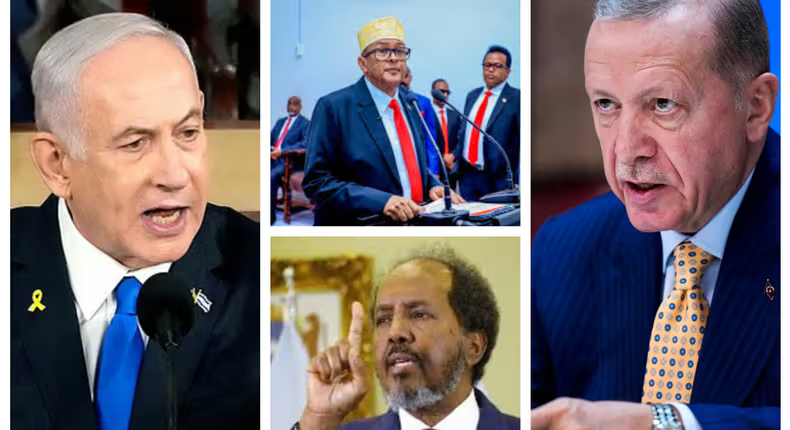
Somalia Unionist Factions are Stirring up Divisions inside Somaliland

Somalia Unionist Factions Stirring up Divisions inside Somaliland

Fostering Internal Fragmentation to Block Clean Breaks

Prologue

As a researcher who spent years immersed in East African affairs, I’ve always been drawn to the intricate web of histories, identities, and power struggles that define the region. It’s a place where resilience shines through chaos, but also where old wounds fester in unexpected ways. A few years back, I wrote an article called “The Dutch Paradox,” exploring how the Netherlands, a nation that clawed its way to independence through bloody revolts against Spanish rule, later turned around and inflicted some of the most brutal colonial regimes on places like Indonesia and South Africa. It was a stark reminder that the fight for freedom doesn’t always translate to empathy for others’ struggles. That lens has shaped how I see the Somali situation today: a people united by so much, language, faith, culture, yet torn apart by the very divisions they sometimes wield as weapons. It’s what I call the Somali Paradox, where Somali unionists are actively stoking internal rifts in Somaliland to sabotage its push for a clean, recognized breakaway, all while Somalia itself hangs together as a fragile patchwork of semi-independent states. In this piece, I’ll draw on my experiences and observations to unpack this irony, blending history, current events, and a bit of forward-thinking, in hopes of humanizing the stakes for everyone involved.

Abstraction

At its core, the Somali Paradox is about how Somali unionist factions are stirring up divisions inside Somaliland to weaken its case for international recognition as a separate country. It’s a tactic that feels almost poetic in its contradiction, promoting splits to prevent a split, especially since Somalia operates as a loose federation that’s always one crisis away from falling apart. Drawing from my time in the region and parallels to historical paradoxes like the Dutch one, this article walks through the colonial roots, the failed dream of a Greater Somalia, the brutal civil war of the 1990s, and Somaliland’s quiet success in building its own path since 1991. We’ll look at the here-and-now, including Israel’s bold recognition of Somaliland on December 26, 2025, which has thrown fuel on the fire amid swirling debates over Somali diaspora politics, whispers of Palestinian resettlement, and Ethiopia’s hunger for sea access. Using insights from diplomatic chatter, news outlets, and the raw voices on social media, I’ll weigh whether this paradox can hold up long-term. We’ll touch on moves to chip away at Somaliland by carving out places like Awdal and SSC-Khatumo, and explore what comes next: the dangers of endless division versus the promise of real talks that could lead to peace and shared growth, maybe even as two separate states under a bigger Somali umbrella.

Introduction

I’ve often heard Somalis described as one of the most unified ethnic groups in Africa, sharing a single language, a deep Islamic faith, and a nomadic heritage that transcends borders. But you see the cracks nowhere better: colonialism’s arbitrary lines, fierce clan loyalties, and outside powers pulling strings. This ideal of unity masks a messy reality, and nowhere is that clearer than in the Somali Paradox. It’s the way pro-union forces quietly or not so quietly, encouraging fractures within Somaliland to stop it from gaining full independence, all to cling to the idea of a single Somalia on the map.

This strategy has ramped up since Israel shocked the world by recognizing Somaliland as a sovereign nation on December 26, 2025, the first UN member state to do so. I remember the buzz among my contacts in the Horn; it wasn’t just about borders, but how it tangled with bigger storms: Ethiopia’s desperate need for a port, wild rumors about relocating Palestinians from Gaza, and even U.S. election-year drama involving Somali-Americans like Rep. Ilhan Omar and barbs from Donald Trump. Somalis around the globe reacted with raw emotion, anger, betrayal, a sense of being under siege, especially with rising anti-Muslim sentiment in the West fueling the fire.

In response, unionists are doubling down on splintering Somaliland, pushing for breakaway pockets like Awdal in the west and SSC-Khatumo in the east, much like Somalia’s own clan-run states such as Puntland or Jubaland. It’s division to fight division, and it begs tough questions: Will this really stop Somaliland’s momentum? And what’s best for ordinary Somalis, a bunch of feuding mini-states under foreign thumbs, or some kind of negotiated setup where everyone wins? In my Dutch Paradox piece, I argued that nations often repeat the cycles they escaped; here, Somalis risk doing the same, using fragmentation as a tool when it once tore them apart. This article pulls together threads from history, today’s headlines, and online conversations, aiming for a fair shake from all sides: Somalis in Mogadishu, Somalilanders in Hargeisa, regional players, and the diaspora I’ve connected with over years.

Historical Trends: From Colonial Scars to Broken Dreams

The roots of Somali division go back to the late 1800s, when European powers sliced up Somali lands like a pie: the British in the north and Italians in the south. I’ve personally seen how these borders still haunt people, stories of families split, resources fought over. The British approach in the north was hands-off, letting clans handle their affairs, which bred a unique sense of self-reliance. Down south, Italian rule was harsher, more top-down, setting the stage for resentment.

When independence hit in 1960, the north and south united as the Somali Republic, with British Somaliland independent for just five days before jumping in. It was all fueled by the romantic idea of Greater Somalia, reuniting all Somalis. But under Siad Barre’s 1969 regime, that dream turned nightmare, the disastrous Ogaden War with Ethiopia in 1977-78 crushed spirits and sparked rebellions. Northern Isaaq clans bore the brunt, facing what many call genocide, like the 1988 bombing of Hargeisa that killed tens of thousands. Survivors speak louder even today; their pain is palpable, a reminder of how unity imposed by force crumbles.

Barre’s fall in 1991 unleashed hell in the south, warlords, famine, terrorists like Al-Shabaab. But in the north, clans gathered at the 1993 Borama Conference, reclaiming independence as Somaliland on May 18, 1991, back to those old British borders. They’ve built something remarkable: elections, stability, a functioning government, all without recognition. Meanwhile, Somalia’s 2012 constitution created a federal system with autonomous states like Puntland (born in 1998) and Jubaland (2013), each with their own armies and deals. It was meant to embrace clan differences, but it’s just deepened the divides, with constant squabbles over money and power. It’s this very model that unionists are now trying to force on Somaliland, echoing the Dutch irony: fighting for your own freedom, then denying it to others.

Current Situation: Israel’s Move and the Web of Tensions

Israel’s recognition of Somaliland on December 26, 2025, felt like an earthquake. Prime Minister Netanyahu called it backing a “real, working state” in a tough neighborhood, and Somaliland’s President Abdirahman Mohamed Abdullahi hailed it as a breakthrough, talking security ties, trade, and even embassies. Then came Foreign Minister Gideon Sa’ar’s visit to Hargeisa on January 6, 2026, stressing Red Sea safety and poking at “virtual” states like Palestine. For Israel, it’s about strategy, eyes on the Houthis, maybe a foothold at Berbera Port.

The backlash was fierce. Somalia blasted it as an attack on its sovereignty, with protests in Mogadishu and emergency parliament meetings. President Hassan Sheikh Mohamud tied it to alleged Palestinian relocation plans from Gaza, denied all around, but the rumor mill churned. The African Union held a crisis session on January 6, slamming the move and calling for reversal, fearing it could unravel anti-terror work. Djibouti cut flights to Somaliland starting January 7, Yemen cried foul, the EU stuck to Somalia’s borders, and the UN Security Council debated amid warnings of chaos.

It all links back to Ethiopia’s 2024 deal with Somaliland: leasing coastline for a naval base, maybe in exchange for recognition, Somalia sees it as theft. Add in U.S. tensions, with Trump’s 2025 comments against Somali immigrants and Omar pushing back on ICE raids, and it’s a powder keg. On social media platforms like X, it’s a mix: Somalilanders cheering “historic courage,” U.S. reps like Chris Smith calling for America to follow, while unionists warn of “neocolonial games.

As someone who has closely followed the Horn of Africa for years, listening to elders and sharing their stories, debating with unionists over long phone calls, and now tracking the passionate voices emerging both at home and in the diaspora, fiery threads on X, and heartfelt conversations with friends from Minneapolis to London, I firmly believe that Israel’s recognition of Somaliland has dramatically supercharged the Somali Paradox. What might once have remained a slow-burning, largely internal debate has suddenly been thrust under an intense global spotlight, sharply illuminating, and, in many ways, deepening, and the local fractures that have long simmered just beneath the surface.

The Somali Paradox: Creating Many Splits to Stop Somaliland Departure 

At the core of the Somali Paradox lies a calculated strategy: Somali unionist factions are deliberately engineering multiple internal splits within Somaliland to thwart its singular, clean break toward independence, thereby safeguarding the illusion of a unified Somalia. Somalia itself functions as a patchwork of semi-autonomous clan-based entities, such as Puntland and Jubaland, which operate like independent mini-states with their own militaries, resources, and foreign policies, yet these same forces are now exporting this model northward to undermine Somaliland’s cohesion and international appeal. For instance, in the western region of Awdal, home to the Gadabuursi and Ciise clans and a longstanding unionist stronghold, recent protests have featured crowds waving Palestinian flags in defiance of Israel’s recognition, while armed groups seize territory and key figures defect to align with Mogadishu. Locals increasingly decry Somaliland as a “one-clan show,” dominated by the Isaaq and allegedly sustained through coercive force since its 1991 declaration. Similarly, in the east, SSC-Khatumo’s decisive 2023 victories expelled Somaliland forces from Las Anod, establishing the area as Somalia’s sixth federal member state and highlighting how these engineered divisions portray Somaliland as fractured and unworthy of sovereignty.

This approach of fostering numerous splits to block one major division carries profound risks, as it not only erodes Somaliland’s stability but could boomerang to exacerbate Somalia’s own vulnerabilities. Post-Israel’s recognition, Somaliland authorities have intensified crackdowns, arresting imams and scholars who criticize the move and monitoring religious sermons, which further tarnishes their image of democratic governance and plays into unionist narratives. Unionists argue that legitimizing “de facto” entities like Somaliland accelerates widespread fragmentation, hollowing out central authority, while Somalilanders counter that their secession is an escape from Somalia’s dysfunctions, where groups like Al-Shabaab often outmaneuver the federal government in providing order. As one of my contacts poignantly put it, “Division feeds the extremists; unity starves them.” Yet, by mirroring its federal chaos onto Somaliland, potentially reducing its control to just 65-70% of claimed territory amid non-Isaaq clan resistance and the specter of civil war, Somalia invites broader balkanization across the Horn. This echoes the Dutch Paradox I explored in my earlier work: a nation that fought fiercely for its own unity, only to impose divisive colonial tactics elsewhere, perpetuating cycles of instability rather than breaking them.

Future Pathways: Can the Paradox Last, and What’s Best for Somalis?

Short-term, yeah, this tactic could stall things, making Somaliland seem unstable and scaring off more recognitions. Israel’s step might encourage the U.S. UK and other countries to follow, but Awdal and SSC-Khatumo show the cracks. Long-term, though? It could backfire, boosting Al-Shabaab, clan wars, and outsiders. Analysts I’ve followed warn of redrawn maps, more terror, and Israel stirring the pot against Turkey’s Somali ties.

What’s truly in Somali interests? Not endless mini-states under foreign watch that just breeds dependency. Better: sit down on a round table and negotiate. Give and take is the only sustainable way out. Some see recognition as a “dangerous spark” in the Horn; others, a smart reset for stability. On conversations on social media platforms like X; it’s split: one post says Israel came “too late” as Somaliland shrinks to a “tribal enclave,” another bets on economic wins drawing more allies.

Paths ahead: dug-in divisions leading to total breakup, a recognition wave solidifying Somaliland-Other countries bonds, or deals that heal Somali wounds. From my Dutch Paradox view, breaking cycles means choosing empathy over repetition.

Conclusion

The Somali Paradox lays bare the painful gap between rhetoric of unbreakable unity and the fractured realities on the ground. Israel’s recognition, just over a week ago, followed by high-level visits, AU condemnations, and regional backlash, has exposed these fault lines more vividly than ever, intensifying efforts to splinter Somaliland while underscoring Somalia’s own persistent vulnerabilities.

Tactical internal divisions may temporarily delay Somaliland’s clean break by magnifying clan dissent and painting it as unstable, but they invite far greater perils: renewed civil war, proliferating terrorism, and escalating geopolitical tensions across the Horn, as cautioned by the UN, AU, and regional leaders.

For the Somalis I’ve come to know, from resilient diaspora entrepreneurs rebuilding lives abroad to pastoralists navigating daily hardships at home, the sustainable way forward lies in pragmatic, inclusive agreements that honor diverse identities and aspirations. Whether through strengthened federalism, a loose confederation, or even respectful coexistence as two states, mediated dialogue could address not just internal matters but also other geopolitical interests.

Transforming paradox into genuine progress requires setting aside division as a weapon and embracing shared prosperity instead. It’s ultimately a deeply human story, one of a proud people charting a path through inherited pain toward a more secure, self-determined future amid relentless global pressures.

Unlocking America’s Leverage in the Strategic and Highly Contested Red Sea

Unlocking America’s Leverage in the Strategic and Highly Contested Red Sea

Mr. President,

Jan 4, 2025

I write on behalf of the Somaliland American Strategic Advisory Group to urge decisive U.S. action to re- recognize Somaliland and formalize a strategic partnership

Recent developments—including bipartisan congressional initiatives, the African Union’s 2005 fact finding conclusions, and Israel’s recognition of Somaliland—have created a narrow but consequential window to advance American interests in the strategic and highly contested Red Sea corridor and the Horn of Africa.

Bipartisan Congressional Momentum:
Congress has already taken substantive steps on Somaliland policy through bipartisan measures reflecting growing interest in formal ties and strategic cooperation. In the Senate, the Somaliland Partnership Act mandated reporting and feasibility studies and was introduced with bipartisan sponsorship. In the House, the Republic of Somaliland Independence Act (H.R. 3992) has been introduced and referred to committee, signaling additional support for reassessing U.S. policy. Together, these actions demonstrate cross party recognition that U.S. strategy in the Horn of Africa requires new tools and credible partners.

Legal and Historical Justification:
Somaliland became independent before Somalia and possesses more than a century of distinct political history and national identity—76 years under British Protectorate rule, 34 years of self-governance, and only a 30-year union with Somalia marked by violence. It was recognized by 35 nations upon independence in 1960. Its union with Somalia was voluntary and never ratified by a binding treaty. Somaliland’s 1991 withdrawal is supported by international legal principles, including the Vienna Convention on the Law of Treaties and the right to self-determination. (See: “The Case for the Independent Statehood of Somaliland,” American University International Law Review.) In a national referendum, over 89% of Somalilanders voted in favor of independence.

African Union Findings:
The African Union’s 2005 fact finding mission concluded that Somaliland’s political development and governance merited serious consideration, describing its statehood claim as “historically unique and self-justified.” The mission explicitly recommended engagement rather than isolation. This internal AU assessment undercuts claims that recognition would violate regional norms and provides a credible African basis for principled U.S. engagement.

Recent Diplomatic Shift:
Israel’s formal recognition of Somaliland in December 2025 marks the first instance of state level recognition and materially alters the diplomatic landscape. This development creates momentum for allied coordination and practical geopolitical cooperation while increasing the strategic value of timely U.S. leadership to shape outcomes.

Why Now and What to Do:
Somaliland offers secure logistics through the Berbera Port and Air Base, a stable democratic partner in a volatile region, and a geopolitical buffer against malign influence. Recognition and partnership with Somaliland—unlike with Somalia—do not entail open ended nation building. By recognizing Somaliland, the United States can secure a reliable ally, strengthen regional security, and advance long term national interests without the burden of failed aid programs or protracted military engagements. At the same time, the United States would gain basing access, defense cooperation opportunities, and commercial entry into Somaliland’s energy and mineral rich economy.

We recommend the following immediate steps: appoint a Special Envoy to initiate formal talks; direct the Departments of State and Defense to negotiate bilateral agreements on logistics, defense, and security initiatives; and coordinate with Congress to authorize targeted economic investment facilitation with appropriate oversight.

Mr. President, the convergence of congressional momentum, the African Union’s findings, and Israel’s recognition presents a strategic opening the United States should not cede. Acting now would secure U.S. access to a critical maritime chokepoint, expand economic opportunities for American firms, and strengthen a democratic partner in one of the world’s most strategically contested regions. We stand ready to brief your team and support an interagency process to implement these recommendations.

________________________________________

Respectfully,
IYussuf M. Issa
Somaliland Strategic Advisory Group
Ashburn, Virginia https://slsag.org

Somaliland Sovereignty Predates the Creation of Somali Republic and its Territorial Integrity

Somaliland Sovereignty Predates the Creation of Somali Republic and its Territorial Integrity.

What if the most repeated claims about Somaliland are wrong? What if the idea that its separation is a recent rebellion, that its people were always committed to pan-Somali unity, or that Israel’s move represents a sudden colonial intrusion collapses under even minimal historical scrutiny? And what if the real scandal is not Israel’s recognition of Somaliland, but how thoroughly the international system has ignored facts it once openly acknowledged?

Just a day after Christmas, on 26 December, a video call landed on the Somaliland president’s iPhone. On the other end was Benjamin Netanyahu, informing him of a decision that would detonate diplomatic outrage across Africa, the Middle East and the United Nations. Nothing about this moment was spontaneous. It was the endpoint of a long, calculated and largely clandestine process in which symbolism mattered far less than geography, intelligence and hard power.

To understand why this recognition matters, one has to begin with an inconvenient historical truth: Somaliland is not a breakaway region invented in 1991. It is a former British protectorate that became an independent state in June 1960, was recognized by more than thirty countries, and entered a voluntary union with the former Italian Somalia five days later. That union was political rather than organic, rushed rather than deliberative, and never subjected to a referendum in Somaliland itself. When it collapsed three decades later amid mass violence, Somaliland did not secede from a functioning state; it withdrew from a failed one and reclaimed a sovereignty it had already possessed.

This alone sits uncomfortably with the joint statement issued by Arab, Islamic and African states condemning Israel’s move as a violation of international law and an unprecedented assault on territorial integrity. The statement speaks as though Somaliland were a newly invented “region”, yet omits the fact that its statehood predates the Somali Republic itself. It invokes the sanctity of borders while ignoring that Somaliland has consistently defended colonial-era boundaries, whereas the Somali state openly rejected them through the doctrine of Greater Somalia. It warns of dangerous precedents while overlooking the dozens of cases in which self-determination has been selectively endorsed or denied depending on geopolitical convenience.

Declassified intelligence from the period before independence exposes how fragile the nationalist narrative always was. A 1948 CIA assessment of political organizations in British Somaliland noted that none were “purely political in character” and that they largely pursued “individual tribal or regional interests”. It estimated that only three or four per cent of the population belonged to any political party. Most explosively, it stated that the Somali Youth League, later mythologized as the voice of all Somalis, “does not have an appeal for the residents of British Somaliland”. This was not the verdict of a hostile power seeking to undermine unity, but an internal intelligence assessment written decades before Somaliland’s later rupture with Mogadishu.

The same document described early Somali nationalism as explicitly pan-Somali and dismissive of inherited borders, committed to uniting “all the inhabitants of the Somali countries”. That ideology would later become state doctrine in Mogadishu. Somaliland’s subsequent rejection of it was not a betrayal of some shared national soul; it was a continuation of a political culture that had always been cautious, localized and sceptical of ideological centralism. In this sense, Somaliland’s post-1991 governance — built around clan conferences, negotiated consent and decentralization — looks less like an anomaly and more like a return to form.

Israel’s role enters this story not as a sudden act of provocation, but as a long-term strategic calculation shaped by geography and threat perception. Somalia as a unified state never had meaningful relations with Israel. From the 1960s onward it aligned itself with pan-Arab causes, framed Israel as an imperial enemy, and became one of its most hostile critics in international forums. Somaliland, by contrast, was recognized by Israel in 1960 and quietly revisited that history after restoring its independence in 1991.

What followed, according to multiple Israeli and regional media reports, was years of discreet engagement managed largely outside formal diplomatic channels. Mossad is reported to have cultivated relationships with Somaliland’s leadership, laying political and security groundwork well before any public recognition. Israeli officials have openly thanked the agency’s leadership for its role. Key Somaliland leaders are said to have made several secret visits to Israel in 2025, meeting senior political, defense and intelligence figures. None of this was advertised, because recognition politics in Africa and the Arab world remain unforgiving.

The strategic logic is blunt. Somaliland sits on the Gulf of Aden, overlooking the Bab el-Mandeb strait through which a significant share of global trade passes. It lies within a few hundred kilometers of Houthi controled territory in Yemen, whose missiles and drones have reshaped security calculations across the Red Sea. From Berbera, Israel and its partners can monitor maritime traffic, detect launches, and project power at distances that radically alter response times. Israeli commentators have described the relationship as a force multiplier against the Houthis. Western security planners see similar advantages.

This also explains why the United Arab Emirates looms so large in the background. Long before Israel’s recognition, Abu Dhabi invested heavily in Berbera’s port and airport, reportedly turning them into advanced logistical and military facilities. The UAE’s absence from the joint condemnation statement was therefore less a mystery than a confirmation. Somaliland fits neatly into a wider Emirati strategy of controlling ports, trade routes and maritime choke-points from the Red Sea to the Horn of Africa, often operating beyond the authority of weak central governments.

China, too, factors into the equation. Its naval base in Djibouti and expanding presence along African trade routes have unsettled Western planners. Somaliland offers an alternative foothold in a region where influence is increasingly contested. From this perspective, Israel’s move is not only about countering the Houthis or extending the Abraham Accords, but about anchoring itself and its allies in a rapidly militarizing maritime corridor.

It is here that the most incendiary allegations emerge, particularly claims that Somaliland was discussed as a potential destination for Palestinians displaced from Gaza. These reports, widely circulated but officially denied, have inflamed regional reactions and colored interpretations of Israel’s motives. Whether such plans were speculative, exploratory or entirely fictitious, their very plausibility in public discourse speaks to how little Somaliland is treated as a political community in its own right, and how readily it is imagined as empty strategic space.

The backlash has been swift and severe. Fourteen UN Security Council members condemned Israel’s recognition; the African Union rejected it outright. Turkey warned of a strategy to fragment Islamic states. Somalia framed the move as an existential threat. Yet much of this outrage rests on selective memory. Somaliland is condemned for claiming self-determination, while states that suppress separatist movements within their own borders present themselves as guardians of international law. Israel is accused of expansionism, while Somalia’s own pursuit of Greater Somalia is quietly erased from the record.

None of this absolves Israel of opportunism, nor Somaliland of hard-nosed calculation. This was not an act of idealism. It was a transaction shaped by intelligence cooperation, shared threat perceptions and the cold logic of geography. It will intensify rivalries in the Horn of Africa, sharpen competition in the Red Sea, and test already fragile regional orders. It may also, paradoxically, force a long-overdue reckoning with Somaliland’s unresolved status.

The question now is whether the international community can continue to deny a political reality that intelligence agencies documented decades ago, that dozens of states once acknowledged, and that more than 39 years of effective self-rule have only reinforced. In the coming years, as the Horn of Africa becomes an ever more critical arena of global competition, that denial may prove more destabilizing than recognition itself.

by Nilantha Ilangamuwa is a founding editor of the Sri Lanka Guardian

Somaliland and Israel – Considerations for Recognition and Cooperation

Somaliland and Israel – Considerations for Recognition and Cooperation

In the Horn of Africa and the Red Sea – a space whose security-strategic importance to Israel has been prominent again in the past two years – Somaliland, an independent and pro-Western country, is established, which is not recognized by the international community. Its ultimate goal is to gain international recognition and establish alliances with countries that will help it against its enemy: the Somali government of Mogadishu. In recent years, she has been establishing close ties with the UAE and Taiwan. The rise of the Trump administration and the presence of senior Republican officials who support recognition of it are given hopes to the leaders of Somaliland, and against this background its efforts to gain recognition have been increased, including against Israel. This article examines the issue of relations with Somaliland for Israel, while presenting the supportive and inhibiting Israeli recognition of it.

Somaliland – over thirty years of independence and stability

Somaliland spans the northwestern part of what the international community recognizes as a wholesale. Somaliland was independent for five days in 1960 before joining the Union with Somalia, and was reborn as an independent state in 1991 from the brutal and long-term Somali Civil War that has been taking place since the late 1980s. Somaliland is based on a unique and separate identity that has been formed in the last hundred years: the territory was under British colonial rule (unlike the rest of Somalia, which was under Italian rule); its people have extensive ties with southern Yemenite over the other side of the Gulf of Aden where it borders; and most of its population is among the members of the Isak clan – unlike the rest of the Somalia inhabited by other clans. The Isak suffered from discrimination and violence—and even claim to have genocide—from the clans that ruled Somalia-Mogadishu, especially in the 80’s.

Since its actual independence in 1991, Somaliland has been an antithesis for taking place in Somalia: its security situation is benign, its internal arena is stable, has no significant jihadist activity, and although there are border disputes at its ends (especially in the districts where other clans live), they are specific and polluted. Since the 2000s, Somaliland has been conducting a stable and proper multi-party democratic system, with a permanent election, the last of which took place in 2024 and announced a peaceful and orderly change of government. All the significant political forces operating in it are pro-Western and suspicious of Islamist forces or China and Russia. Although they are divided on the methods of action, they all see international recognition as a supreme goal.

The fact that Somalia-Mogadishu’s problems are concentrated in the south helps the survival of Somaliland, which is far from the battlegrounds between the various clans and the powerful government of Mugheyshu and the powerful Al-Shabaab organization. In addition, Somaliland borders on relatively friendly and stable governments: Ethiopia, Puntland (an independent state actually member of the Somalia Federation), and Djibouti. With them, Somaliland had peaceful and improved relations: In 2024, Somaliland signed a strategic understanding agreement with Ethiopia, which was supposed to give the unaccessible Ethiopia to the sea a foothold in the strategic port, Barbara, insinuating future recognition of her independence (this agreement was effectively frozen, but not canceled, under Turkish-Somali pressure). Somaliland’s ties with Djibouti are also improving, and in October 2025 she signed a “Nairubi Agreement” with Puntland for security and commercial cooperation.

In recent years, Somaliland has also developed its ties with other pro-Western countries. Taiwan and the UAE are its two most strategic partners: Taiwan – the chip manufacturing giant – is investing in the development of the country’s rare metal and mineral mines, and the UAE has invested a fortune in the development of the port of Barbara. As far as the UAE is concerned, Somaliland is a strategic stronghold in the Horn of Africa alongside the other Maozia in the region – on the Yemenite island of Socotura, in Puntland, and Darfur.

Even with the United States, Somliland has reasons for cautious optimism. American delegations—including from the Pentagon—have visited the country, which markets itself as a potential strategic base for the United States in the region. President Trump said the United States is considering recognizing it, and the U.S. Congress is interested in ordering the State Department to re-examine ties with Somaliland to improve them and upgrade them. As an intermediate stage, U.S. lawmakers aim for the State Department to start separating Somalia from Somalia and Somaliland in the context of travel warnings. Republican officials, such as Senator Ted Cruz of Texas, frequently express themselves in their support for recognizing Somaliland’s independence. However, the Americans have heavy considerations that are urgent to avoid recognition, along with delays in appointments and policy formulation for Africa and the Red Sea.

Against this background, Somaliland is conducting a lobbying campaign to promote the issue of recognition. In May 2025, the Somalilan President appealed to the UN members to recognize it as an independent state. During October 2025, the media in Somaliland reported that more than 20 countries, including Israel, are approaching the decision to recognize it. Somaliland is also more correct to adopt additional sovereign features: in November 2025, it declared full control of its airspace (by disconnecting it from the symbolic sovereignty of Somalia), demanding that it be authorized by a direct permit from its authorities to move in the sky, and announced that it would not recognize visas received from the Government of Mogadishu.

International recognition by other countries is therefore the primary target for the various Somliland governments (it remains one even after the exchange of government in democratic elections). International recognition will determine the existence of Somaliland and grant it protection, at least it hopes, from a scenario in which Somalia is reinforced (one or with its allies) will be able to act in the future international legitimacy to re-apply its authority to the territory. Alongside international recognition, Somaliland strives to acquire reliable and powerful allies. The danger from the government of Mogadishu is now still imaginary, but Somaliland has more tangible concerns than other security threats, from the Houthim, through the spread of global jihad (which is currently active in neighboring Pontland), to separatism in the periphery of the territory and even subversive activity that has evidence on the ground by China and Turkey.

Importance of Somaliland to the West and Israel

The importance of Somaliland lies in its geostrategic location and correctness – especially as a stable, moderate and reliable country in a volatile region – to cooperate in a comprehensive and broad manner with Western countries. The location of Somaliland at the entrance to the Gulf of Eden – opposite southern Yemen – connecting the Red Sea to the Indian Ocean, gives it a geo-strategic uniqueness. This is the historical reason that the British Empire took over in the late 19th century, and that the United States during the Reagan administration established a military base in the 1980s, in the midst of the Cold War.

Today, the distance between the waters and territory of Somaliland and the Houthi control areas in Yemen, the port of Hadida, for example, is about 300 to 500 km. The fact that in recent years the Gulf states, the United States and Israel – each in turn – have fought the Houthis without a decision, gives the location of Somaliland and the potential ability to operate from its territory, considerable global importance, within a possible equality voucher. Somaliland has a potential to be a frontal base for a variety of missions: intelligence surveillance against the Houthis and their empowerment efforts; providing logistics to the legitimate Yemeni government in its war against the Houthis; and a base for direct operational activity against the Houthi – offensive and to thwart Houthi attacks at sea or by means of drones. The necessary parallel to Israel’s steadfast alliance with Azerbaijan, which has significantly upgraded the strategic and operational Israeli ability to deal with the Iranian threat. It is possible that Somaliland is the equivalent brick for Israel in the face of the Houchi threat.

Alongside the valuable location of Somaliland, it is equally important that its government is interested in cooperating broadly with pro-Western countries. It’s a combination of willingness and ability. Eritrea is located in an even closer location to actions against the Houthis, but police are anti-Western and friendly to Iran. Djibouti, who has the strategic location, maintains actual neutrality in conflicts. Ethiopia lacks access to the sea and relations between police and the United States are ambivalent. Somaliland therefore offers a unique combination of geo-strategic location and a willingness to agree to widespread cooperation with pro-Western countries. Its ties with the UAE – that much of the logic that guides them from a utterance point of view was the war in the Hothis – are evidence of this. Messages coming out of Somaliland indicate that the state is also willing to have broad security relations with the United States, including hosting an American base, and even with Israel.

Regarding Israel, the positive attitude of the Somaliland government is evident, even in the midst of the war in the past two years, and it is likely that there are already unofficial ties between senior officials in both countries. Somaliland has sent messages in recent months that it is ready to cooperate with pro-Israel initiatives, including the expansion of the Abraham Agreements. The public discourse in the country tends to be pro-Israel, although there are also critical voices, especially in light of the war and reports from the Gaza Strip, as well as in light of the existence of Salafi movements (non-violent) in the country.

Considerations for and against recognition of Somliland

For Somaliland, the most coveted prize is American recognition, with which, they estimate, will come recognition from many other countries close to Washington. She therefore invests effort in front of the White House and Congress. Somaliland positions itself as an antagonist for China who is willing to go as a long way to realize American interests in the strategic space of the Red Sea and the Indian Ocean. In the face of the Americans, Somaliland also emphasizes its democratic and free character and hostility to radical Islamist ideologies. In conversations with American officials and media messages, she clarifies her immediate readiness for entering the Abraham Agreements. Her desire to gain recognition was so great that the Somaliland government did not even publicly reject the discourse that took place a few months ago about plans to encourage the immigration of Gazans into its territory, despite the great unpopularity that the idea has sparked in its population.

However, despite the friendliness of Washington and the strategies of Somaliland’s location, the United States still seems to be hesitant about the question of official recognition, and it has serious reasons for this.

First, on a fundamental level, U.S. policy on the Somali issue has been consistent in recent decades: recognition of the idea of “one Sommalia.” The United States has sought to strengthen the Mogadishu government, especially in light of its difficult war against Al-Shabaab over the past two decades. For the United States, Somalia-Mogadishu is an ally, also weak and failing. The United States also provides it with military assistance in the attacks against global jihadist elements. Recognition of Somliland will see as an American betrayal, which could lead to the wave of the blast in the shaky Somalia (for example, by officially withdrawing from Fontland and Jubald – both of which are still a symbolic commitment to Mogadishu’s authority – or the strengthening of Al-Shabab). This consideration should be added to international practice – an aspiration not to recognize the changes in unilateral borders or in quitting countries, with the understanding that this is a possible opening of the Pandora’s box and an appeal of existing borders in the rest of the world, especially in the Middle East and Africa.

Although this is a weighty consideration for Status-Quo-like U.S. administrations, the Trump administration may be able to violate the tradition of adherence to the idea of “one Somalia” or the reluctance to recognize quitting countries. However, there is a consideration that probably plays a more significant role for Washington at the present time: the support of most Arab countries including Saudi Arabia, Qatar and Egypt, as well as Turkey in this idea. The Arab League countries, except the UAE, are declaratively supporting the unity of Somalia and strongly opposed the recognition of Somaliland. For Turkey, Somalia-Mogdeishu is a major ally in the Red Sea region, bordering on the status of a protectorate. These powerful countries, which are mined ear in Washington, express their aversion to the possibility of recognition of Somliland.

Although their impact on Washington is much less, the African Union countries are also inclined to deeply disapprove of any official recognition of quitting countries, fearing the domino effect in the rest of Africa.

Compared to the considerations of the United States, Israel has additional considerations: Although the Qatari and Turkish attitudes against recognition of Somliland are not significant (and vice versa), it is possible that the Egyptian position, and perhaps also Chinese, is more significant. On the other hand, Israel’s proximity to the UAE reinforces the pro-Somalland consideration. However, traditionally, Israel is hesitant to recognize quitting countries, partly for fear of precedents or a boomerang effect on the issue of recognition of a Palestinian state, although this consideration seems to be less relevant at the present time, due to the actual, almost sweeping recognition that the Palestinian “state” has won in recent years.

A more significant consideration for Israel, which is supposed to arouse caution and deep thought before official recognition of Somaliland, is actually a pragmatic aspect. Israeli recognition of Somaliland, which is not accompanied by American recognition, may cause a negative effect that will harm both Israel and Somaliland. While an Israeli-Somalian agreement may appear to be reinforcement of Israel’s status in the region, at the same time causing a strong counter-reaction in the Muslim world, which in turn may place Somaliland at the focus of regional criticism and, consequently, lead to a reluctance to expand public or substantive cooperation with Israel. Israeli recognition, ironically, may actually contain efforts to expand the Abraham Accords with other Muslim countries.

Under the threshold of consciousness, at least for now

Israel is required for allies in the Red Sea area, in part to prepare for the next campaign against the Houthis. Somaliland is an ideal candidate for this cooperation, who will be able to grant Israel as a matter of action near the scene of operations. But in addition to security cooperation, relations with Somaliland also have important economic-conscious potential for Israeli national security, due to the minerals in its territory and the desire to establish relations with Muslim populations in the region. Therefore, Israel must work to expand cooperation with this entity, ideal while cooperating with the UAE and the United States.

However, Israel has serious reasons for avoiding the first country to recognize Somaliland, which is primarily an understanding that such recognition may actually act against promoting intimate relations between Israel and Somaliland due to regional responses and dynamics. As long as the United States (or at least the UAE) does not recognize Somaliland as an independent state, Israel must not act alone on this official level.

The recommendation is therefore to promote the intimate relationship with Somaliland “under the threshold of consciousness.” Israel and its allies in Washington can help Somliland in persuasion attempts with the Trump administration, but the United States must take the first public step to recognition. At the same time, the two countries can promote – even before official recognition – security and economic partnerships, the establishment of interest offices (as many other countries with Somaliland do), and even symbolic measures such as recognition of the Somaliland passports.

These are steps that will prevent the possible risks involved in official recognition, while at the same time helping both parties to advance their fundamental interests. Israeli security and economic presence in Somliland does not necessarily require official recognition, and on the other hand, Somaliland may also be preferable to intimate and quiet relations with Israel over high-profile precedent-setting declarations. Somaliland can benefit many of these ties with Israel, especially in light of the security challenges that the country may encounter in the challenging neighborhood of the Red Sea and the Horn of Africa. For Israel, Somliland may be a “vigilance breaker” in the struggle against the Houthis.

** The author wishes to thank the staff of the Institute for National Security Studies for fruitful discourse on the issue, including as part of a guest lecture given by the author at the Institute on September 30, 2025; Dr. Rashid Abdi, head of research at the Sahan Institute in Kenya, for discourse and sharing of knowledge; and the Israel-Africa Relations Institute for support and encouragement.

The opinions expressed in the publications of the Institute for National Security Studies are those of the authors only.

Fraudulent Somali e-Visa Scheme Defrauds U​.​S. Travelers, Undermines Homeland Security

Fraudulent Somali e-Visa Scheme Defrauds U​.​S. Travelers, Undermines Homeland Security

Large amounts of humanitarian and development aid to Somalia were drastically cut or halted due to concerns about efficiency and corruption as the Trump administration canceled a big portion of USAID’s projects worldwide, primarily affecting third-world nations. This action had a detrimental effect on the weak economy of Somalia. As a result, Somalia’s feeble government turned to terror techniques to steal money from travelers visiting other Horn of Africa nations such as Somaliland.

In order to put an end to this banditry, Somaliland-American community members and stakeholders are bringing it to light.

We are a coalition of U.S. citizens and dual nationals who have fallen victim to a deliberate scheme of consumer fraud and coercion perpetrated by the Government of Somalia’s Immigration & Citizenship Agency (ICA). The ICA is actively selling e-visas for travel to Somaliland, a service they know to be invalid, as Somaliland’s Immigration authorities consistently reject these documents at their ports of entry.

The consequences for travelers are severe and costly. Those relying on the fraudulent Somali e-visa for Somaliland travel are routinely stranded, miss flights, are denied entry, and incur significant additional expenses. They have to pay again for a valid Somaliland visa on arrival and face the possibilities of being sent back at their own expense.

Of even greater concern is the demonstrably inadequate capacity of the Somalia Federal Government to protect the sensitive personal information of U.S. travelers, as reported by multiple reliable sources, including the United Nations. This failure poses a serious data security risk and represents a direct threat to U.S. homeland security.

If you’re a native of Somalilnad who is currently an American citizen or resident, we seek your immediate support. We are appealing to U.S. regulatory and diplomatic bodies to halt this malicious scheme, and we need your voice.

Please exercise your rights by adding your name and signature to our appeal, and we deeply appreciate your support for this critical and time-sensitive matter

Somaliland Strategic Advocacy Group, Virginia, USA

SomalilandUSA@protonmail.com

Ethiopian Airlines Scraps Somalia’s e-Visa Requirement for Somaliland Bound Travel

Ethiopian Airlines Scraps Somalia’s e-Visa Requirement for Somaliland Bound Travel

An electronic visa system was recently implemented by the Somali government for visitors to Somalia, including areas that are not under its direct authority. The e-visa, which costs $64 each entrance, was created to expedite the admissions process and bring in money for the federal government. Passengers traveling to Somaliland, which has operated freely for more than thirty years while without international recognition, are more perplexed because of the change.

Travel issues rapidly flare up after airlines servicing Somali locations, including Somaliland, were told to make sure every passenger had the e-visa before boarding. Many Somali diaspora members and local authorities who were traveling to Hargeisa complained about challenges and lengthy layovers, especially when using transit hubs in the United Arab Emirates.

For travelers going to Somaliland, Ethiopian Airlines stopped enforcing Somalia’s new e-visa requirement.

This latest development comes after Republic of Somaliland authorities issued an order threatening to ban foreign airlines if they require travelers to obtain a Somalia’s e-visa. Subsequently, Ethiopian Airlines effectively disregarded Mogadishu’s directive by permitting visitors to Hargeisa to receive visas upon arrival at the Egal International Airport.

Another significant airline that operates flights to Somaliland, FlyDubai, is also under pressure to choose whether to abide with Somaliland’s directive or risk being banned from landing in Hargeisa.

Ethiopian Airlines action has angered Somali officials. After Ethiopian Airlines ceased implementing Somalia’s new e-visa requirement for travelers visiting Somaliland, Mohamed Nur Tarsan, Somalia’s former ambassador to Kenya, urged President Hassan Sheikh Mohamud’s administration to take decisive action against the airline.

DP World Funded New Science Lab for SUNSAT In Somaliland

DP World Funded New Science Lab for SUNSAT In Somaliland

“Continuous investment underscores DP World’s commitment to education, sustainability, and community development in Somaliland.”

DP World Berbera has handed over a new, science laboratory to Sheikh University of Natural Science and Technology (SUNSAT), fulfilling a US$250,000 commitment made in 2022 to advance education and empower future generations in Somaliland.

The state-of-the-art facility will enhance the university’s research and practical learning capabilities in petroleum and mining, engineering, hydrology, environmental sciences, and information and communication technology – fields critical to Somaliland sustainable development.

Supachai Wattanaveerachai, CEO, DP World Horn of Africa, said: “This project reflects DP World’s belief that education drives sustainable growth. By investing in Sheikh University, we are supporting Somaliland vision to build a generation that is equipped with knowledge, skills and innovation that is required in shaping the nation’s future. We are confident that this new laboratory will strengthen science education, open new opportunities for students and create long-term impact for the community.”

Sheikh University of Science and Technology is a community-owned public university located in the mountain-top town of Sheikh in the Sahil region. The laboratory investment is part of DP World’s broader education portfolio in Somaliland, which includes scholarship programs at Abaarso Secondary School and Barwaqo University – a fellowship initiative running from 2019 to 2031.

The handover ceremony brought together government officials, university committee members, community leaders, and local stakeholders. The laboratory handover reinforces DP World’s belief that trade and education go hand in hand – empowering people, improving livelihoods, and enabling lasting progress for the communities it serves.

DP World has also invested in major infrastructure projects including the Berbera Economic Zone (BEZ) and an upcoming edible oil terminal, both aimed at strengthening Somaliland trade ecosystem and creating local employment opportunities.

SUNSAT Lab Building

About DP World

DP World is reshaping the future of global trade to improve lives everywhere. Operating across six continents with a team of over 100,000 employees, we combine global infrastructure and local expertise to deliver seamless supply chain solutions. From Ports and Terminals to Marine Services, Logistics and Technology, we leverage innovation to create better ways to trade, minimizing disruptions from the factory floor to the customer’s door.

New Maritime Gateway: UAE to Somaliland

New Maritime Gateway: UAE to Somaliland

DP World has unveiled a new strategic shipping route linking Jebel Ali Port in the UAE to Berbera Port in Somaliland

Operating every nine days, the service strengthens DP World’s global network and enhances Berbera position as a key logistics hub and maritime gateway in East Africa.

The Jebel Ali–Berbera route improves trade connectivity between the Gulf and East Africa, providing a faster maritime link to Somaliland. Scheduled stops at Aden and Djibouti further expand access to vital port cities, enabling smoother connections to markets across the Horn of Africa.

From Berbera, cargo can reach inland destinations, including Ethiopia, offering an alternative to the traditional Djibouti Port-dependent overland routes. The service also promises more predictable transit times while mitigating risks from regional bottlenecks.

Berbera Port features a 1,050-metre quay with a 400-metre section capable of handling Triple E vessels, extensive bulk and break-bulk facilities, and an annual livestock handling capacity of around four million heads.

Ganesh Raj, group chief operating officer, Marine Services at DP World, said, “The Jebel Ali to Berbera service further complements our investment drive into Africa. Building on the significant infrastructure we have developed across the continent, the service enhances connectivity for our customers as we continue to boost trade links between the Middle East and East Africa.”

“In doing so, we are supporting the growth of resilient, sustainable corridors that unlock prosperity for our partners, customers and the communities we serve,” he added.

Berbera is home to the region’s most modern container terminal and the Berbera Special Economic Zone (BSEZ), designed to attract foreign investment and support long-term industrial growth.

DP World holds a 58.5% stake in the Berbera container and general cargo terminal, providing deep-water access to major East–West shipping lanes. The nearby Berbera Economic Zone further accelerates local industrialisation, while the port handles over 4.1 million heads of livestock annually, generating trade worth more than US$1bn.

Community initiatives, including training the region’s first “Solar Mamas” as solar-energy technicians, illustrate how trade infrastructure can deliver economic and social benefits.

Supachai Wattanaveerachai, CEO, DP World Horn of Africa, commented, “The launch of this new corridor is a milestone in our ambition to build faster, safer, and more reliable trade routes. It reflects our commitment to creating meaningful economic benefits for businesses and communities in the region.”

“Our work in Berbera is already stimulating trade and industry, while supporting wider community development. Looking ahead, this service will strengthen Berbera role as a gateway for East Africa’s future growth and prosperity,” he added.

Facebook LinkedIn WhatsApp

Al-Shabab: Designated Terrorist Group Outperforms Somalia’s Government in Basic Governance

Al-Shabab: Designated Terrorist Group Outperforms Somalia’s Government in Basic Governance

Privately, representatives of humanitarian and development organizations often confide that Al-Shabab would be a more efficient partner than the federal government.

Although Mogadishu is nominally under federal government control, Al-Shabab tax collection is more efficient, and many business owners prefer dealing with the militants. “Al-Shabab tax system is predictable and transparent,” said a Mogadishu-based NGO director who has worked extensively in rural Somalia, and asked not to be named so they could speak freely.  “The amounts levied are fixed, and you can even appeal their decisions in their courts,” explained the director. “At roadblocks on rural roads, Al-Shabab provides receipts that allow you to avoid double taxation.”

Compare that to government checkpoints “where you basically need to pay a variable bribe to get through. It is pocketed by the collectors, which means you will be taxed again at the next checkpoint,” the NGO official added. His opinion is confirmed by a research paper studying checkpoint politics in southern Somalia.

The group’s influence extends far beyond its rural strongholds. It directly governs nearly a quarter of all district capitals in Somalia, and co-governs almost all areas nominally held by the federal government outside the autonomous region of Puntland and the Republic of Somaliland.

Recent studies by independent research organizations such as the Hiraal Institute, SaferWorld, and the International Crisis Group consistently show that Somalis view the group’s governance as efficient, compared to the corruption-plagued federal system.

This uncomfortable reality – that an internationally designated terrorist group outperforms Somalia’s government in basic governance – also emerges from my experience working as deputy director for the International NGO Safety Organization in Somalia from 2016 to 2018, and extensive field research conducted in the country for my PhD between 2019 and 2022.

Why Al-Shabab governance works

The militants have built their administrative success around creating a comprehensive system that extends far beyond military control. Their approach demonstrates how effective administration can emerge from understanding local needs and implementing consistent policies. The group replicates detailed governance systems from village to national level, with clear hierarchies and accountability mechanisms.

At the heart of Al-Shabab appeal lies their justice system. The group’s Islamic courts have earned recognition, even from critics, for delivering swift and decisive rulings that are actually implemented across their territory. Unlike Somalia’s federal courts, where cases can languish for years and outcomes often depend on elite connections or bribes,Al-Shabab judges operate under strict rotation schedules, with their clan identities kept secret to ensure impartiality. The system’s credibility is reinforced by the lack of impunity – even senior Al-Shabab members face prosecution in their own courts when accused of wrongdoing.

Security provision forms another cornerstone of the group’s governance model. In territories under their control, crime and inter-clan violence have become rare. Al-Shabab maintains an absolute monopoly on violence, treating even possession of unregistered weapons as a punishable offense. This security dividend, despite taking the form of a protection racket in government-controlled areas, enables normal economic activities to flourish, and allows the population to live in peace – if they are willing to follow the militants’ strict regulations.

The group’s ban on popular stimulants like qat and tobacco, while resented by users, is appreciated especially by women concerned about the drain it imposes on the household economy.The group’s economic policies reveal a sophisticated understanding of Somalia’s structural challenges. Al-Shabab promotes economic self-reliance, encouraging consumption of locally produced foods over imports like rice and pasta, and frowning on processed foods and soft drinks filled with “chemicals” as unhealthy foreign products.

The group regulates cash crop exports to ensure domestic markets aren’t undercut by export-oriented production, and some districts under their control have experienced faster growth than nearby government-controlled areas.

Environmental protection represents one of Al-Shabab most unexpected governance innovations. The group has enacted comprehensive environmental regulations, including bans on tree-cutting, charcoal production, and plastic bag use. While initially ridiculed by international observers, these policies address serious environmental degradation in a country facing severe deforestation and an ecological crisis.

In recent agreements with local clans, Al-Shabab has explicitly named environmental protection as a condition for allowing continued traditional self-governance, demonstrating how they integrate conservation into their broader political project. This comprehensive governance model creates a self-reinforcing cycle of legitimacy. Effective service delivery builds public acceptance, which enables more sophisticated administration, which in turn allows for more ambitious policy implementation. The result is a governance system that, while rejecting liberal democratic norms, addresses many of the practical needs that Somalia’s international-backed government has failed to meet.

The humanitarian challenge

Al-Shabab has developed substantial humanitarian capabilities that operate independently of international aid systems. In the famine of 2011-2012 that killed a quarter of a million people, many victims were blocked from accessing international aid by the group, causing a popular backlash and a drop in popularity. Since then, they have improved their aid delivery capacity, funded primarily through zakat collected from local populations, supplemented by Gulf-based Islamic charities.

During the 2017 drought that threatened famine conditions across Somalia, no starvation deaths were reported in Al-Shabab controlled areas, suggesting their distribution efforts were effective rather than merely propaganda exercises. Nevertheless, the group’s humanitarian approach reflects their broader critique of international aid dependency. Its officials consistently argue that Western food aid disrupts local markets and disincentivizes Somali agricultural production.

The neutrality of NGOs is indeed questionable, as Western donors often direct aid to increase the acceptance of the federal government by the Somali population, a practice called “stabilization” in areas recently captured from, or contested by, Al-Shabab. Access to education, health, food aid, and other basic services provided by NGOs is then presented as a benefit of living under federal government rule.

The clan challenge

Perhaps Al-Shabab’s most significant achievement lies in its management of Somalia’s clan-based social structure. Both before and after the establishment of the independent state of Somalia in 1960, clan identity has dominated Somali politics, contributing to the state’s collapse in 1991, and hampering subsequent reconstruction efforts. Al-Shabab has positioned Islamic law (sharia) above traditional clan law (xeer) for the first time in Somali history. This represents a fundamental shift from collective clan responsibility to individual accountability – a change that even critics acknowledge as potentially transformative.

The group either co-opts or appoints and rotates clan elders, organizing them by geographic districts rather than clan lineage. This weakens links between local communities and broader clan families, while strengthening ties between different clans in the same region. “Al-Shabab in that sense is a modernizing force, as it exposes Somalis to being governed by the rule of law,” noted Hussein Sheikh Ali, a former director of the Hiraal Institute think-tank. “We face a per-modern society. Most people in Somalia have never dealt with modern laws; they haven’t even felt governed.”

Despite this apparent governance success, Al-Shabab faces a crucial paradox: legitimacy without popularity. While Somalis may recognize the group’s administrative competence and align with its ideology up to a degree, it appears most do not want to live under Al-Shabab rule.

Implications for international policy

These findings pose uncomfortable questions for the international community’s approach to Somalia.

Many of the stated objectives of international state-building efforts – establishing the rule of law, reducing corruption, transcending clan politics, and promoting individual responsibility – are being achieved by “terrorists” while the federal government’s progress in these fields is excruciatingly slow.

The federal rule of law exists on paper only, legislative and executive positions continue to be allocated on a clan-basis instead of through elections and merit, and much if not most international assistance is embezzled or allocated along those same clan lines.

The current strategy of treating Al-Shabab as a terrorist organization to be eliminated militarily has proven ineffective for nearly two decades. The group has survived constant pressure from African Union forces, Somali government troops, and US drone attacks – consistently adapting and maintaining its grip on a majority of the population in central and southern Somalia.

Recent military offensives by the Hassan Sheikh Mohamud government – while achieving initial successes – have seen momentum wane as Al-Shabab reasserts control over “liberated” areas. Local populations remain skeptical of the government’s staying power and maintain ties with the militants regardless.

This presents another dilemma for policymakers and humanitarian actors. Engaging with Al-Shabab risks legitimizing a designated terrorist organization and potentially violating counter-terrorism laws. Yet, ignoring the reality of the group’s administrative control perpetuates a parallel system that may ultimately prove more durable than the internationally supported federal government.

Privately, representatives of humanitarian and development organizations often confide that Al-Shabab would be a more efficient partner than the federal government to achieve food security, establish health facilities, mitigate the effects of climate change, and improve physical infrastructure.

Khatumo – the 6th Federal Member State – and Mogadishu’s Calculations

Khatumo – the 6th Federal Member State – and Mogadishu’s Calculations

In a remarkable development, an expanded local conference held in Las Anod in July 2025 announced the formation of Somalia’s sixth federal state – the Northeastern State of Somalia, also known as Khatumo. This newly declared state encompasses the regions of Sool, Sanaag and Ayn, which remain contested by Somaliland and Puntland. These two states have rejected this development, denouncing it as a threat and a strategic maneuver by Mogadishu to reinforce its federal authority. This step risks heightening tensions and deepening political and tribal polarization in a region already plagued by a fragile and complex legal and political environment.

The central government in Mogadishu has maintained strong support for the emerging situation in the northeast. This started with supporting the armed tribal movement led by the Dhulbahante and Warsangali clans in February 2023. The movement gained momentum culminating in the defeat of the Somaliland army in August 2023 and the establishment of the Khatumo administration – a reality Mogadishu provisionally recognized in October 2023.

Further solidifying its support, Mogadishu formally accepted the new administration as a full member of the Somali federation, designating it as the sixth regional state. This decision followed a controversial visit by Somali Prime Minister Hamza Abdi Barre to Las Anod, the capital of the new state, in April 2025. Furthermore, the Somali federal government has played a pivotal role in establishing the new state (the northeastern state) and provided it with legitimacy. This marks an important juncture in the history of this region and reflects the aspirations of marginalized communities to reclaim their key historical role in shaping Somalia’s national political framework.

The central government in Mogadishu considers itself the primary beneficiary of this new reality. Its key motives and calculations for redrawing Somalia’s political map include the following:

First, Advancing Centralist Orientations: The rise of the new state contributes to the recalibration of the federal balance of power in favor of the central government. This shift enhances Mogadishu’s weight in shaping national policy and potentially expands its reach over regional states. It also positions Mogadishu to play a decisive role in shaping the political elite of the new federal member (Las Anod). The new state is expected to align more closely with centralist visions of governance and future power dynamics within Somalia.

Second, Undermining Somaliland’s Sovereignty Agenda: Mogadishu and unionist elites in southern Somalia have taken the lead in creating the Northeastern State with the aim of delivering a severe blow to Somaliland’s long-standing bid for independence based on colonial-era borders (the former British Protectorate). The government of President Hassan Sheikh Mohamud has sensed troubling shifts in international and regional attitudes toward the Somali question, with an increasing interest in Somaliland at the expense of Somalia. Notably, signs of a changing mood in Washington suggest a potential reconsideration of the “One Somalia” policy, raising the possibility of formal recognition for Somaliland.

Khatumo State and its geographical boundaries as they appear on the map

Third, Curtailing Puntland Influence: Mogadishu’s support for Khatumo reflects a desire to empower Las Anod to chart its own course, independent of Puntland agenda. This approach disregards Garowe concerns, particularly regarding federal plans to reorganize local forces and militias – formerly affiliated with the Khatumo administration – to integrate them in the federal army. Garowe interprets these moves as a calculated move to alter regional power dynamics and impose federal control. Such changes could reduce Puntland territorial scope, reshape its social fabric and limit its ability to maintain influence, autonomy and strategic balance.

Fourth, Pursuing Economic, Geo-strategic and Demographic Objectives: The region is believed to hold significant hydrocarbon reserves. It also occupies a key strategic location that enhances the federal state’s access to the Gulf of Aden. This positioning serves as a hedge against potential shifts in international focus toward Somaliland and Puntland, which could undermine Mogadishu’s strategic relevance. Additionally, the central government may seek to weaken entrenched tribal dynamics which dominate the Somali political landscape by altering the demographic composition in areas dominated by rival clans. This includes challenging the influence of the Isaq and Darod clans in Hargeisa and Garowe, respectively, while reinforcing the position of the Hawiye clan, to which President Sheikh Mohamud and most of the elites in the center belong.

Fifth, Conveying Messages to the International Community and Somalia’s Partners: Through its actions, Mogadishu aims to project growing confidence in its ability to manage both internal and external affairs independently. In return, it expects foreign actors to recognize and engage with the federal government as the legitimate authority that is capable of guiding Somalia out of its prolonged crises. This includes asserting control over constitutional reforms, managing the relationship between the center and the peripheries and setting the terms for foreign cooperation with Somaliland and other regional states.

Somaliland and Puntland Positions and Options 

Somaliland and Puntland share common concerns regarding the fate of disputed territories, particularly Sool, Sanaag and Ayn. Somaliland has firmly rejected the creation of the Northeastern State on territories it considers “under its jurisdiction.” Hargeisa views this move as an attempt by Mogadishu to exert political influence through tribal affiliations, potentially inciting internal conflict. It also sees the development as part of a broader strategy to undermine its authority, destabilize its governance and  derail its aspirations for international recognition as an independent state.

Similarly, Puntland has strongly opposed this development and pledged to confront it. Garowe perceives the move as a direct threat to its territorial integrity and political authority. It accuses the Federal Government of Somalia of complicity in fragmenting the country. Puntland officials have warned that “the federal government is attempting to divide the nation into conflicting regional entities.”

This situation may prompt both Hargeisa and Garowe to consider possible responses, ranging from reconciliation and collaboration in confronting the central government, to more aggressive actions to challenge the legitimacy of the new administration and dismantle it.

1. Reconciliation and Strategic Alignment: Despite the tension and rivalry that have characterized the relationship between the two stable neighboring regions – Somaliland and Puntland – over the past 30 years, the current crisis may present an opportunity for them to reconcile and collaborate. Recent developments suggest a potential shift in attitudes, which could strengthen their positions and complicate the central government’s efforts to assert control over the disputed territories. A united front could reshape the political landscape and challenge the federal government’s ambitions in the region.

2. Operational Escalation and Strategic Encirclement: Somaliland may view the situation as a window for decisive military action aimed at recapturing the city of Las Anod and surrounding areas, dismantling its opponents’ presence and halting their progress toward federal integration. Puntland, meanwhile, is unlikely to remain passive in the face of such escalation by Hargeisa against Las Anod. It could potentially find itself in conflict with the latter, particularly if the new administration crosses the boundaries set by President Said Deni, which include attempts to extend its administrative reach into areas still under Puntland control, including the Sanaag region.

3. Negotiation and Diplomatic Engagement: This remains the most viable path for resolving Somalia’s current political deadlock. International mediation and support could help facilitate a broader dialogue addressing key issues such as the constitutional crisis and the legal status of the new administration. However, entrenched positions and deep-seated mistrust among Somali stakeholders continue to hinder progress toward peace and reconciliation. For instance, Somaliland President Abdirahman Irro has emphasized that talks with Mogadishu cannot proceed until concerns over sovereignty violations and the establishment of a separate administration are addressed. This suggests that any revival of negotiations between northern and southern Somalia would require a shift in Mogadishu’s approach.

The Consequences of the Creation of the New State and Its Future

The establishment of the new Federal member state in Somalia carries significant implications for the country’s future. It comes at a time of political uncertainty, persistent security challenges and financial strain, compounded by declining external support due to changing priorities among donors. The federal government and its supporters view the new state as a means to enhance national unity, peace, stability and development by integrating regions into the federal framework. However, Puntland and Somaliland view the initiative as a threat to their traditional spheres of influence and sovereignty, prompting strong opposition and resistance to any redrawing of Somalia’s political and administrative map.

Meanwhile, public sentiment across Somalia is marked by a mix of anticipation and cautious optimism. Some view the development as an opportunity to strengthen and expand the federal model and rebuild Somali federalism on the principles of equitable partnership and national unity. Others fear it may further complicate Somalia’s already intricate political dynamics, potentially escalating tensions and conflict both in the region and the country as a whole. Domestic and international stakeholders remain hopeful that these significant changes will prompt meaningful political dialogue among all Somali parties and stakeholders to forge consensus and chart a stable path forward.

The success of the new administration hinges on its ability to establish itself within a politically charged environment rife with tribal rivalries. It faces considerable hurdles in establishing functioning executive and legislative institutions, securing financial and logistical support and ensuring basic security. Most critically,  it must gain recognition and legitimacy, especially from other federal entities, amid a lack of consensus at both regional and federal levels. Without garnering sufficient acceptance from neighboring states, the administration risks remaining a symbolic entity.

Even at the local level, the new federal entity still lacks inclusive cohesion and effective control over all the territories it claims to represent. Skepticism persists among certain tribal groups, especially the Warsangli clan, about fair representation. In the Sanag region, divisions remain between supporters of the new entity and others who maintain allegiance to Puntland political and administrative structures. These tribal and regional contradictions pose significant obstacles to consolidating loyalty and building a unified governance framework.

Summary and Conclusions

The declaration of a new federal state in the Khatumo region of northeastern Somalia has sparked political controversy and deepened divisions among the Somali population. Reactions from the federal government, Somaliland and Puntland reflect growing tensions and competing visions for Somalia’s future. The disputed region’s strategic importance is likely to grow as tribal competition and regional polarization intensify, further complicating the already fragile situation in the country.

Despite the initial enthusiasm from supporters and strong opposition from rivals, the emerging administration faces numerous challenges on its path toward full federal integration. Addressing its fragile legitimacy will require expanding its representative base, resolving tribal divisions, securing both governmental and external support, improving security and living conditions and gaining recognition from other members of the Somali Federation, particularly Puntland. Additionally, mitigating potential threats from Somaliland will be essential to ensuring the stability and viability of the new state.